

Symposium
Movement: From Score to Documentation – Approaches to performance and dance through processes of notation, collection and narration
Organisation
Arta Sperto and Jérôme Leuba, artist
How does a performance or choreographic work come into being? How can it be transmitted, collected and documented? By considering what happens before and after the time of the performance, this symposium will seek to address these questions, which concern the creative process and which most often unfolds on paper.
The symposium draws on scores, notations and other forms of documentation related to the performances programmed as part of DFTL26 and presented in the exhibition at Le Commun. It offers an overview of these questions by bringing together researchers and practitioners—artists, art historians, curators, etc.—who have been involved, in particular, in several publications, most of them published recently.
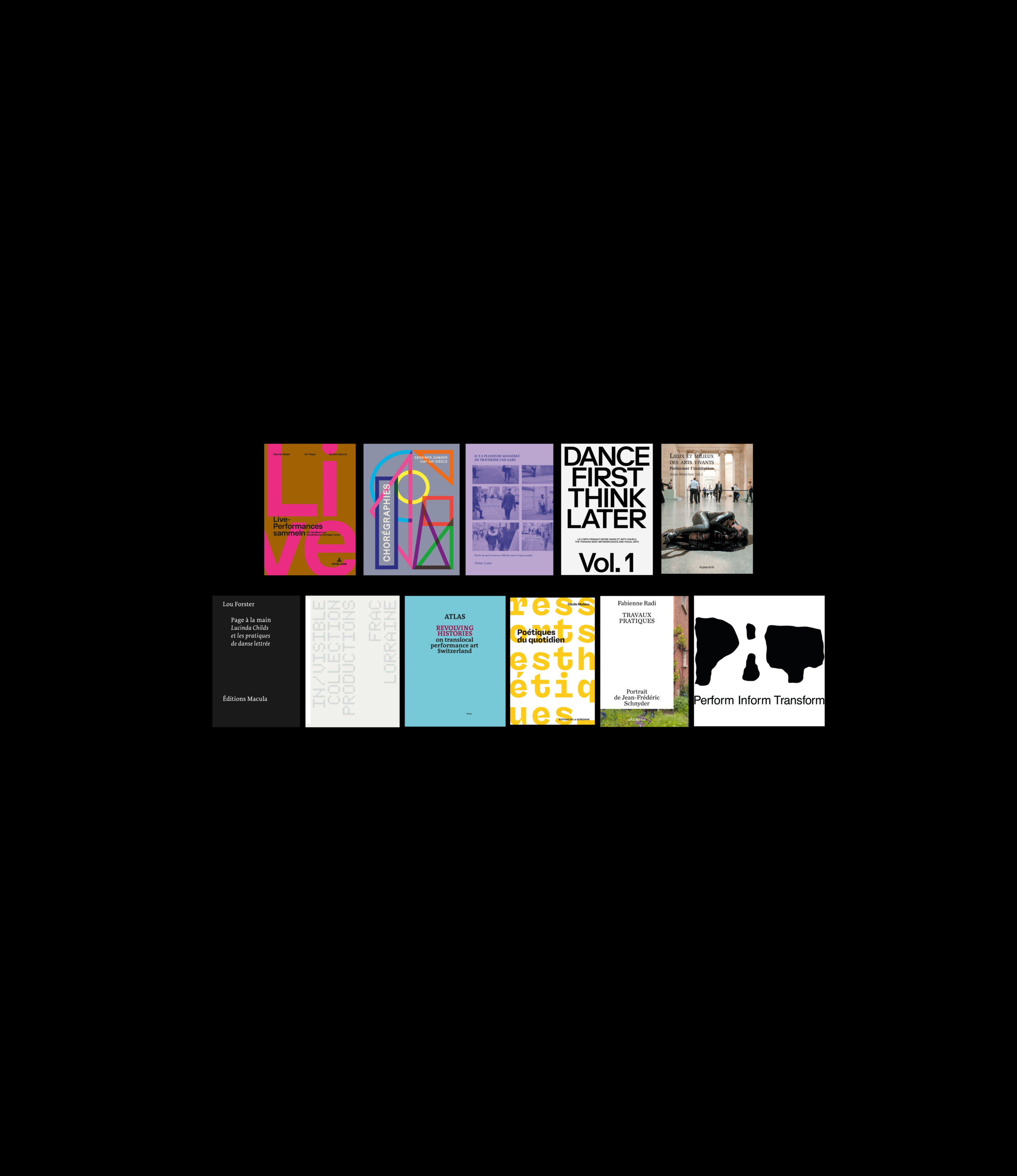
On the occasion of the publication of the following books:
- Il y a plusieurs manières de traverser une gare – Récits de performances infiltrées dans l’espace public, by Jérôme Leuba, with texts by Anne Bénichou, Alain Freudiger, Camille Paulhan, Anaïs Wenger, published by art&fiction publications, 2026
- Life-Performance sammeln. Ein Handbuch zur Handhabung flüchtiger Kunst, published by Peter Lang Verlag, 2026. Research project funded by the Swiss National Science Foundation – Hochschule Luzern HSLU, directed by Rachel Maeder and Wolfgang Brückle, 2026
- Page à la main – Lucinda Childs et les pratiques de danse lettrée, by Lou Foster, published by Macula, 2026
- Chorégraphies. Dessiner, danser (XVIIe-XXIe siècles) – Chorégraphies, écriture et dessin, signe et image dans les processus de création et de transmission chorégraphiques (XVe-XXIe siècles), edited by Pauline Chevalier and Amandine Royer, co-published by INHA, Liénart, Musée des Beaux-Arts et d’Archéologie de Besançon
- Poétiques du quotidien – Le parti-pris du non art, by Cécile Mahiou, Éditions de la Sorbone, 2023
- Lieux et milieux des arts vivants – Performer l’institution, edited by Anne Bénichou, Les presses du réel, 2024
- Travaux pratiques, Portrait de Jean-Frédéric Schnyder, by Fabienne Radi, published by art&fiction, 2026
- Dance First Think Later – Le corps pensant entre danse et arts visuels, vol.1, 2024 et vol.2, 2026, edited by Olivier Kaeser, published by Arta Sperto, distributed by Les presses du réel
Friday, October 23
1:45–2:15 p.m. Welcome, coffee
2:15–2:45 p.m. Olivier Kaeser and Jérôme Leuba, introduction
“Score” + “Documentation” segment
2:50–3:35 p.m. Pauline Chevalier
on the book and the exhibition Chorégraphies: Drawing, Dancing (17th–21st Centuries)
15-minute break
3:50– 4:35 p.m. Lou Forster
on the book Page à la main and the three-part exhibition on Lucinda Childs, currently titled Une subversion du cadre, FRAC Franche-Comté, Besançon
4:40–5:25 p.m. Sabine Gebhardt Fink (in English), Andrea Seamann
on the book Revolving Histories
15-minute break
5:40–6:45 p.m. Guided tour and discussion of the “Dance First Think Later” exhibition-festival and the publication DFTL: The Thinking Body Between Dance and the Visual Arts
15-minute break
7:00–8:00 p.m. Lecture-performance-video Toy Under Development by Geumhyung Jeong (in English)
Saturday, October 24, 10:00 a.m.–6:30 p.m.
10:00–10:30 a.m. Welcome + coffee
“Collection” segment
10:30–11:00 a.m. Anne Bénichou (pre-recorded video; introduction by Jérôme Leuba)
on Lieux et milieux des arts vivants
11:05–11:50 a.m. Béatrice Josse
curator, researcher, educator, and director of FRAC Lorraine from 1993 to 2015, on the FRAC’s collection, as presented in the book In/Visible – Frac Lorraine, Collection – Production (Les presses du réel, 2006)
10-minute break
12:00–12:45 Paul Briottet
Artistic Partner to the Director, BOZAR, Brussels, on PIT—Perform Inform Transform: Participatory Performance in Art Museums, approached from the perspective of a broader curatorial experience in presenting performance in museums
60-minute break
“Narration” segment
1:45–2:45 p.m. Alain Freudiger, Jérôme Leuba, Anaïs Wenger
on the book There Are Many Ways to Cross a Train Station
15-minute break
3:00–3:45 p.m. Fabienne Radi
Portrait, Biography, and Self-Presentation: Or, How I Managed to Write About Nina Childress and Jean-Frédéric Schnyder—a lecture-performance
3:50–4:35 p.m. Cécile Mahiou
Writings on the Everyday and Non-Art: On the Book Poétiques du quotidien
15-minute break
4:50–6:00 p.m. Roundtable discussion with participants; topics selected based on the presentations and discussions
6:15 p.m. Reception
7:15 p.m. End of the symposium
Ongoing:
Jérôme Leuba, battlefield #168, living sculpture, 2026
Le temps d’un livre Bookstore, books for sale
Presentations are in French (unless otherwise noted). They are estimated to last 45 minutes, including Q&A.
The symposium will be filmed and recorded.
Biographical Notes on the Speakers
Anne Bénichou
Teaches art theory and museum studies at the Université du Québec à Montréal. Her research focuses on forms of memory, archives, and historical narratives emerging from contemporary artistic practices and the institutions responsible for preserving and disseminating them. Notably, she published Rejouer le vivant (2020) with Presses du réel on reenactments and edited three anthologies: Ouvrir le document (2010) on documentation, Recréer/Scripter (2015), on the transmission of performative and choreographic works, and Lieux et milieux des arts vivants (2024), on organizations dedicated to the performing arts.
Paul Briottet
Curator, facilitator and producer in the field of live arts and transdisciplinary practices. Artistic associate to the General Director of Bozar in Brussels, and curator of its monthly series of multidisciplinary performances and events, Bozar all over the P(a)lace. Independent curator for the artist residency programme and multidisciplinary festival at Providenza, an agri-cultural centre in Corsica. Deputy Director of the Academy and Concert Programming at the Festival d’Aix-en-Provence until 2024.
Pauline Chevalier
Professor of Contemporary Art History at the University of Tours. Scientific advisor at the Institut national d’histoire de l’art (INHA) from 2018 to 2025. Lecturer at the University of Franche-Comté in Besançon from 2011 to 2025. Co-curator of the exhibition and co-editor of the publication Chorégraphies. Dessiner, danser (XVIIe-XXIe siècles) – Chorégraphies, écriture et dessin, signe et image dans les processus de création et de transmission chorégraphiques (XVe-XXIe siècles), co-published by INHA, Liénart and the Musée des Beaux-Arts et d’Archéologie de Besançon.
Lou Forster
Exhibition curator, art historian and dramaturg, working at the intersection of dance and the humanities. Director of the Heritage, Audiovisual and Publishing Department at CND – Centre national de la danse in Pantin/Paris, starting in 2026. Curator of the exhibitions Lucinda Childs – Danser page à la main at FRAC Bretagne in Rennes, and Lucinda Childs – une subversion du cadre at FRAC Franche-Comté in Besançon (2026). Author of Page à la main – Lucinda Childs et les pratiques de danse lettrée, published by Macula in 2025. Co-director and co-founder of abd, an organisation working at the intersection of dance, research and critical theory.
Alain Freudiger
He studied film history and contributed as a critic to the journal Film, followed by Décadrages. His literary work includes novels (Liquéfaction, Hélice Hélas, 2019), narratives (Arpenté, La Baconnière, 2024) and poetry (Au téléphone, Héros-limite, 2023). His book Le Mauvais génie. Une vie de Matti Nykänen (La Baconnière) received the Grand Prix Sport et Littérature in 2020. He also writes sound pieces and works as an archivist at Radio Télévision Suisse.
Sabine Gebhardt Fink
Professor of Contemporary Art at HSLU – Hochschule Luzern since 2011. Co-editor of Revolving Histories on translocal performance art Switzerland (Atlas and Reader, 2026), together with Andrea Saemann, Chris Regn, Lena Eriksson, Margaret von Büren and Muda Mathis. Author, exhibition curator and editor of publications on contemporary art, including Performance Kronik Basel (with Muda Mathis and Margarit von Büren). Research activities include projects such as Perform Space, The Situated Body, The Relationship of the Arts, Exhibition Displays and Art goes Poetry.
Béatrice Josse
Curator, researcher and educator, developing multidisciplinary projects at the intersection of visual arts, design, performance and writing, in connection with socio-environmental issues. Associate of Utopiana in Geneva in 2026–27, where she is developing an artistic and ecological reflection on hydrofeminism. She directed Le Magasin des horizons in Grenoble (2016–2021) and the 49 Nord 6 Est FRAC Lorraine in Metz (1993–2016), where she initiated a collection focused on immateriality, performance and works designed to be reactivated. A pioneer in questioning the notion of gender, she contributed to making the collection more representative of women artists.
Olivier Kaeser
Director of Arta Sperto, curator of Dance First Think Later (since 2020) and KorSonoR (since 2023). Director of the publication Dance First Think Later – Le corps pensant entre danse et arts visuels, Vol. 1 (2024) and Vol. 2 (2026). Co-director, with Patrick de Rahm, of the publication Arsenic 30 (2022). Curator of the exhibition and editor of the digital publication A escala humana by La Ribot at Sala Alcalá 31 in Madrid (2022). Co-founder and editor-in-chief of Grand Théâtre Magazine in Geneva (8 issues, 2019–2021). Co-director, with Jean-Paul Felley, of the Centre culturel suisse in Paris (2009–2018). Writes texts on art. Member of juries, committees and commissions.
Jérôme Leuba
Artist, researcher, and Associate Professor at EDHEA, HES-SO Valais-Wallis, in Sierre, Switzerland. For the past twenty years, he has been developing a body of work entitled #battlefield, which brings together various media, including video and installation, as well as living sculptures—performative works that he stages in selected public and museum spaces. He has exhibited in solo and group shows at numerous art centres across Switzerland and Europe, and has participated in international artist residencies and received national awards.
Cécile Mahiou
A graduate of ENS de Lyon, she holds a PhD in aesthetics and philosophy of art. She is a member of LAMO (Nantes Université) and the Institut ACTE (Paris 1). An agrégée teacher of modern literature at secondary-school level, she also teaches comparative literature and aesthetics at university. Her recent research focuses on forms of creative action and on the ethical and aesthetic issues surrounding everyday writing. In 2009, she co-founded the online journal Proteus – Cahiers des théories de l’art.
Fabienne Radi
She writes narratives, essays and fiction, and produces artist’s editions, including books, posters, heraldic emblems and records. She taught pop culture and later writing at HEAD – Genève from 2008 to 2025, as well as at the College of Humanities at EPFL in Lausanne from 2015 to 2023. Her initial training in geology and palaeontology gave her a love of layers; a brief foray into library science sparked her enthusiasm for classification; and her later studies in art transformed the way she sees her surroundings. Titles, folds, misunderstandings, haircuts and dentists are recurring motifs in her work. She received the Swiss Literature Award in 2022 for her book Émail Diamant (art&fiction).
Andrea Seamann
Performance artist, curator and network builder. Collaborates within artist-initiated movements and platforms. Co-editor of Revolving Histories on translocal performance art Switzerland (Atlas and Reader, 2026), with S. Gebhardt Fink, C. Regn, L. Eriksson, M. von Büren and M. Mathis. Artistic director of International Performance Art Giswil, a performance art festival in Switzerland (since 2014). Co-founder of PANCH, a professional network for performance artists (2014). Coordinator of the Swiss Performance Art Award (2011–2017). Together with K. Grögel and C. Regn, developed Performance Saga – interviews, performances, events, dedicated to women pioneers of performance art (2002–2012).
Anaïs Wenger
Anaïs Wenger is committed to art and the ways it is shared across a variety of contexts in which artworks circulate and transform. Working at the intersection of visual and performing arts, their practice revolves around narrative as both material and movement, creating a shifting web of relationships. They develop their work in Switzerland and internationally, contribute to publications, and organise exhibitions and performances within collective frameworks.
The symposium is supported by IRAV—the Institute for Research in Visual Arts at EDHEA—the Valais School of Design and University of Applied Arts, HES-SO Valais-Wallis.